


-
Scientific Organizers: Sharon Achilles, Jeanne M. Marrazzo, and Serah Gitome
Important Deadlines
Meeting Summary
Presented in Partnership with Gates Foundation Grand Challenges
Keystone Symposia and Gates Foundation Grand Challenges have teamed up to bring together innovators around the world to find solutions for the most important problems in global health.
About This Meeting:
The vaginal microbiome has emerged as a critical determinant of women’s sexual and reproductive health from menarche to menopause, with profound implications for genital tract infection susceptibility and persistence, fertility, and pregnancy outcomes, including preterm birth. Major scientific advances over the past decade — including high-resolution sequencing, rich data from longitudinal cohort studies, mechanistic immunology, and the first clinical trials of live biotherapeutic products — have demonstrated the protective benefits of a Lactobacillus crispatus-dominant vaginal microbiome, while diverse, dysbiotic communities confer elevated risk across multiple adverse outcomes. Yet critical gaps remain: classification frameworks developed in Western populations may not capture the full spectrum of microbiome states in global settings; host and microbial determinants of durable L. crispatus dominance are incompletely understood; and effective, scalable strategies to establish and sustain protective microbiome states — particularly in the populations with the greatest disease burden — remain elusive.
This meeting will convene leading investigators across microbiology, immunology, obstetrics and gynecology, infectious diseases, epidemiology, bioinformatics, reproductive medicine, industry, and implementation-focused global health to define the next phase of the field. A keynote addressing equity, global diversity, and social determinants of health will frame the meeting, establishing a three-pillar framework — Justice, Equity, and Implementation readiness — that will run as a thread through all subsequent sessions. Six plenary sessions will span the full scientific arc: global microbial diversity and the limits of current classification systems; mechanistic foundations of host-microbe interaction; vaginal microbiome links to pregnancy outcomes; VMB associations with HIV, HPV, and STI risk in the PrEP and HPV vaccine era; the biological and ecological constraints on live biotherapeutic engraftment; and emerging host-directed and molecular strategies to enable durable microbiome control. Together, these sessions are designed to catalyze scientific insight and accelerate translational progress toward sustainable establishment of beneficial vaginal microbiomes that support healthy sexual and reproductive outcomes.
The meeting is intentionally designed to accelerate translation of discovery science to real-world impact. This means moving beyond association studies to mechanism, prediction, and intervention; evaluating the translational readiness of the field's most promising approaches against the clinical outcome targets that matter — preterm birth reduction, HIV and STI risk reduction, and HPV-related disease prevention; and asking at every stage what it would take for advances to be deployable in the populations with the greatest need. A closing plenary address will synthesize the meeting's scientific arc and propose a forward-looking agenda for the field. Attendees will gain a state-of-the-science view of the vaginal microbiome, exposure to robust longitudinal cohort studies and cutting edge multi-omic methods, with opportunities to build collaborations across academia, clinical research, nonprofit institutions, and industry.
What makes this meeting unique is its mechanistic breadth, translational focus, and explicit global health and equity lens—applied at a moment when microbiome science is rapidly maturing into intervention development. The program intentionally elevates LMIC investigators and global perspectives, with plenary and short talk speakers drawn from India, Bangladesh, Kenya, Thailand, Singapore, and sub-Saharan Africa alongside established research centers in Europe and North America. By bringing together the scientists, clinicians, funders, and implementation experts needed to align discovery with delivery, this meeting will accelerate progress toward a future in which vaginal microbiome science reliably improves health outcomes for women worldwide — beginning with the populations that bear the greatest burden.
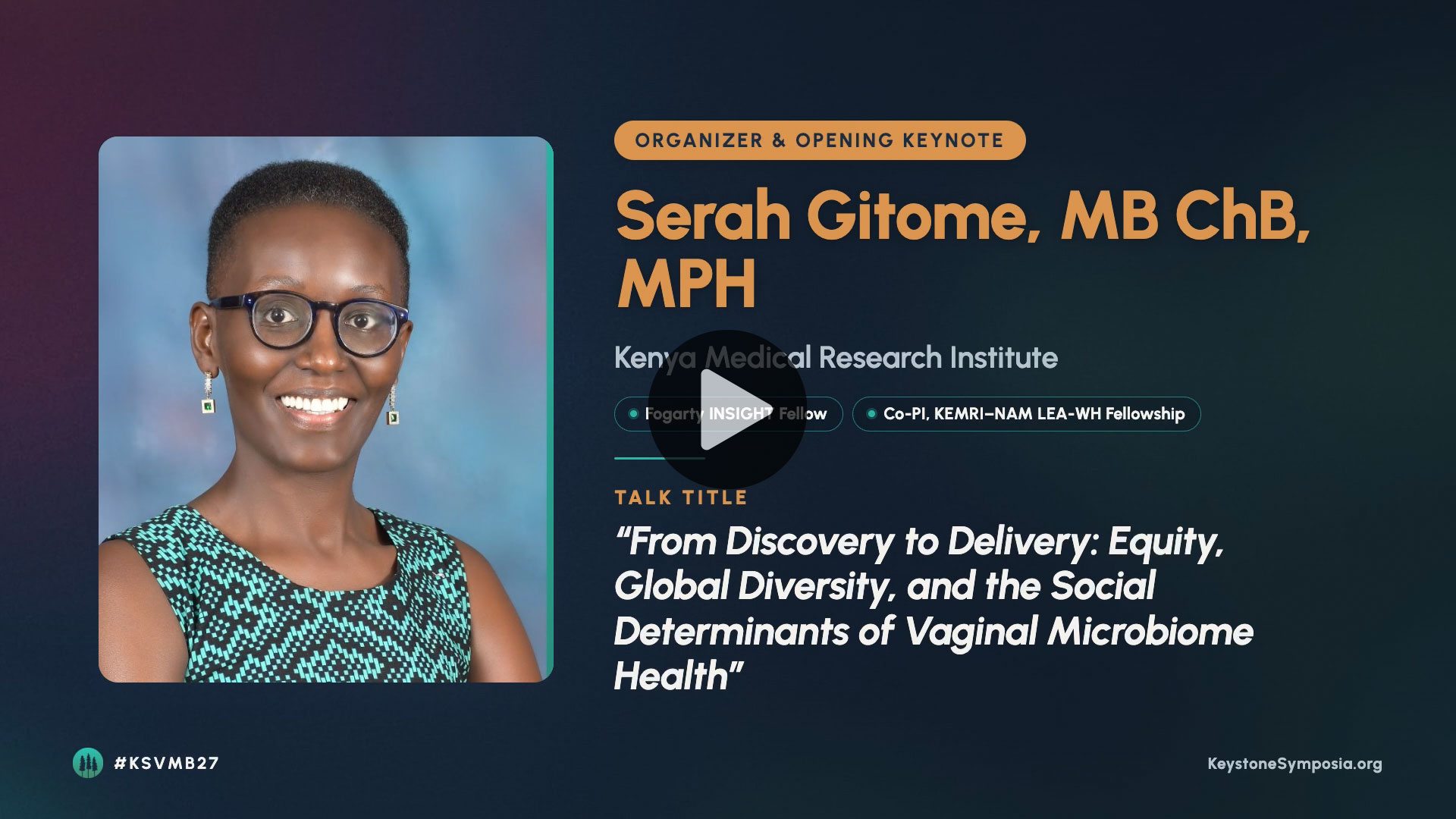
Check out the speaker highlights in the video below:
Unique Career Development Opportunities
This meeting will feature a Career Roundtable where trainees and early-career investigators will have the opportunity to interact with field leaders from across academic and industry sectors for essential career development advice and networking opportunities. Find out more about Career Roundtables here: https://www.keystonesymposia.org/diversity/career-development-initiatives
SPECIAL RECOGNITION:

This meeting is presented in partnership with the Gates Foundation Grand Challenges.